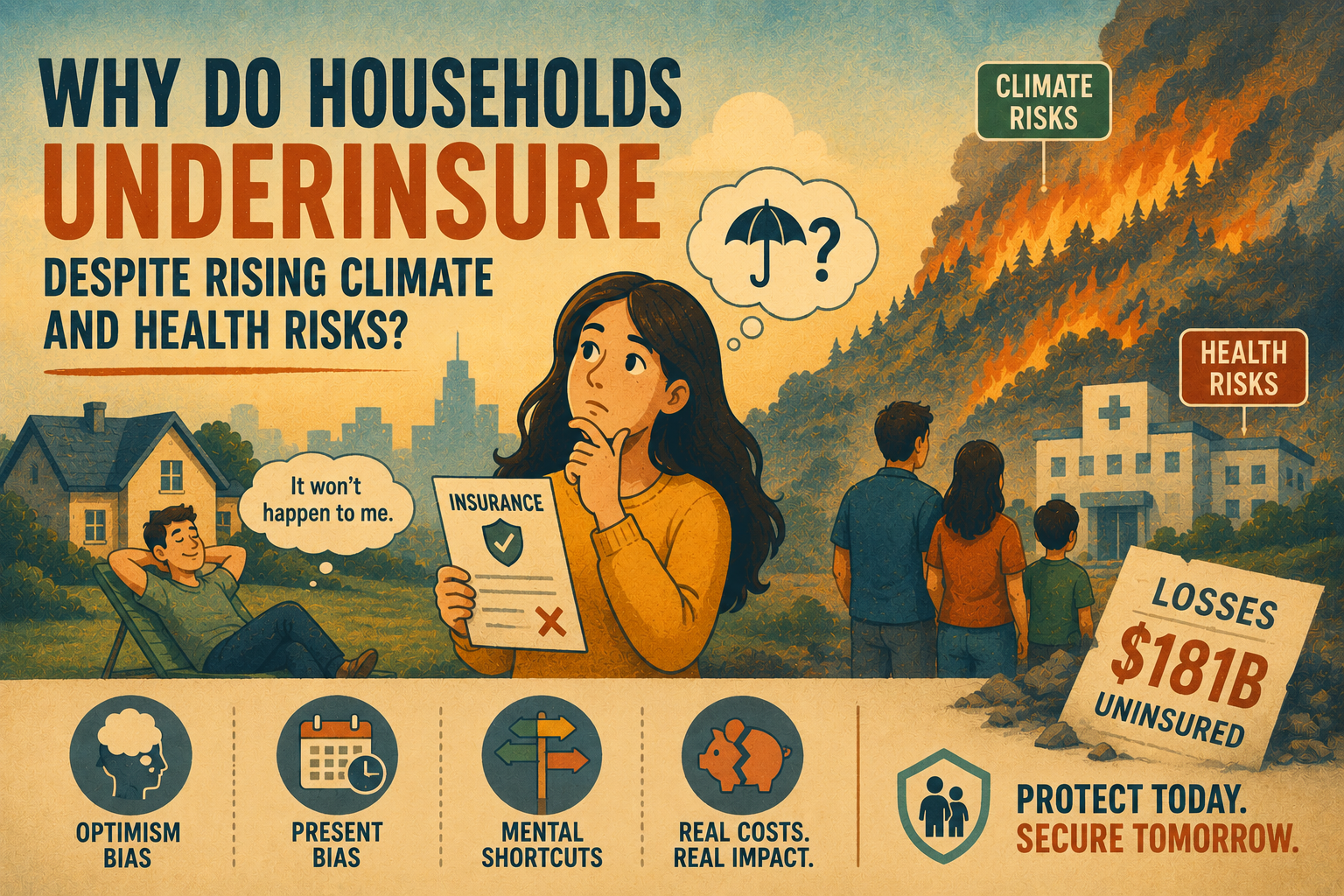
Floods, storms, heatwaves and health emergencies are all becoming more frequent — yet a huge share of the damage they cause is never covered by insurance. Economists call this the protection gap: the difference between the losses people suffer and the losses they insured against. Globally, well over half of losses from natural catastrophes are uninsured. If insurance exists exactly for moments like these, why do so many households buy too little of it?
Small probabilities feel like zero
A rational consumer would weigh the probability of a disaster against its cost and pay a fair premium to cover it. Real people don't think in probabilities. Behavioral economists find that when the chance of an event feels small, we tend to round it down to zero — “it won't happen to me.” A 1-in-50 annual chance of a serious flood sounds ignorable, even though over a 30-year mortgage it adds up to a very real risk. Because the probability feels like nothing, the premium feels like money thrown away.
Insurance is a bad lottery ticket — psychologically
Loss aversion makes it worse. Paying a premium is a certain, immediate loss; the payout is an uncertain, distant gain. Our brains hate certain losses, so the premium feels painful every single year, while the protection it buys stays invisible. People even describe unclaimed insurance as “wasted money” — the opposite of how it should be seen. The best possible outcome of an insurance policy is that you never use it.
Present bias piles on: the cost is now, the benefit is later (maybe never). Just like choosing to scroll instead of studying, households choose lower premiums today over protection tomorrow — or skip the policy entirely.
Availability: no disaster, no demand
Demand for insurance spikes right after a disaster and fades as the memory does. This is availability bias — we judge how likely something is by how easily we can picture it. Research on flood insurance shows take-up jumps after a major flood, then steadily declines in the years that follow, even though the underlying risk hasn't changed at all. The risk didn't shrink; the memory did.
The takeaway
Households underinsure not because they've calculated the risk and rejected it, but because small probabilities feel like zero, premiums feel like losses, and disasters fade from memory. As climate and health risks grow, closing the protection gap may depend less on cheaper policies and more on smarter psychology — defaults, bundling, and framing protection as something you keep rather than something you pay for.