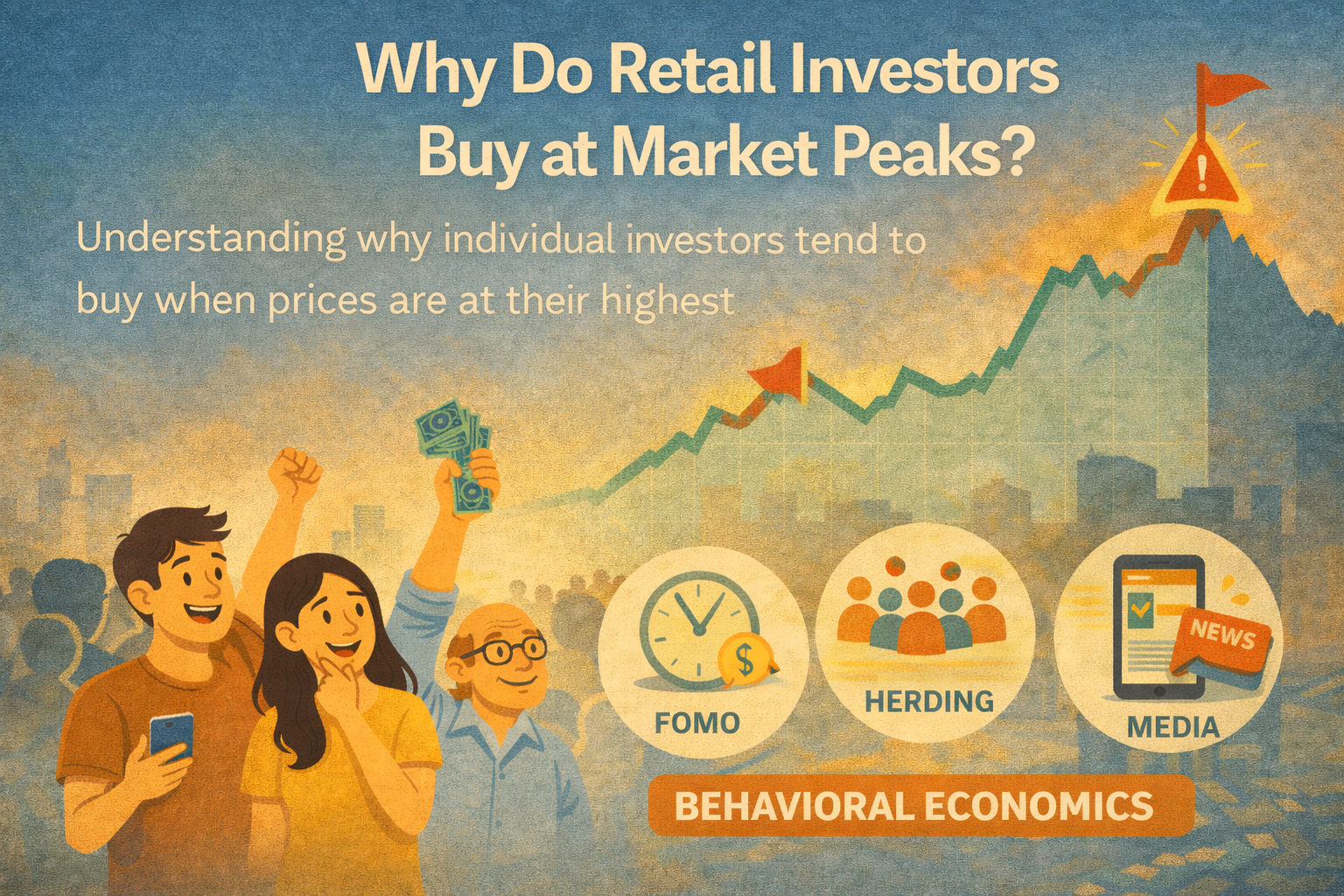
With the growing popularity of retail investing — following the initial surge created by the 2020 COVID pandemic — understanding retail investor trends is critical. Retail investment is inflow from ordinary individual investors rather than large institutions. Common trends indicate that investors tend to buy at market peaks rather than troughs, which does not align with typical expectations. This misalignment challenges assumptions of rational investor behavior — behavior that may be driven by more than logical analysis alone.
Momentum and FOMO
Rising market momentum leads to sentiment-driven rather than rational behavior. According to the National Securities Depository Limited, retail demat accounts rose drastically in 2023 during the bull run that followed the 2020 crash. You'd assume investors buy when prices are low — but the data indicates investing is driven by rising prices and momentum (FOMO) rather than valuation-based entry: performance chasing, not counter-cyclical investing.
Similarly, data from the National Stock Exchange of India shows retail investors accounted for a higher share of cash-market turnover in 2021. As confidence in the economy grew, so did the confidence of small investors — highlighting momentum's role. In 2021, IPO oversubscription ratios exceeding 10x–50x showed herd behavior and narrative-driven optimism pulling more people into the market. Simply put: investors follow trends of optimism.
Extrapolation, anchoring, overconfidence
Biases also shape retail behavior. Extrapolation bias appears when investors see recent strong returns and assume the rise will continue: NSE data shows positive twelve-month index returns are often followed by increased investment via higher net equity mutual fund inflows — recency bias and performance chasing in action.
Also from the NSE: in 2021, retail investors invested heavily even when P/E ratios were above long-term averages — entering precisely when expected future gains were compressed. Buying at high P/E challenges rationality, revealing overconfidence, herd behavior and fear of missing out. Behavioral anchoring appears during bull runs too, where recent peak levels act as an anchor and produce “buy the dip” behavior (Reserve Bank of India Financial Stability Reports).
The media megaphone
According to the Securities and Exchange Board of India, brokerage apps and social media amplify herding bias by spotlighting popular stocks and trades, promoting collective trend-following. Reliance on media rather than analysis shows up in surging searches for “how to invest in the stock market” and rising brokerage account openings during positive index returns. Speculative phases of rapidly rising prices also correlate with narrative amplification in the media — the connection Robert Shiller describes in his Narrative Economics framework.
The takeaway
Retail investment tends to align with the business cycle — procyclical behavior. Regulation or intervention, such as risk warnings or cooling-off periods, may help reduce herding. The effects of momentum, biases and media narratives on retail investors are clear — and they explain why so many buy at the very top.