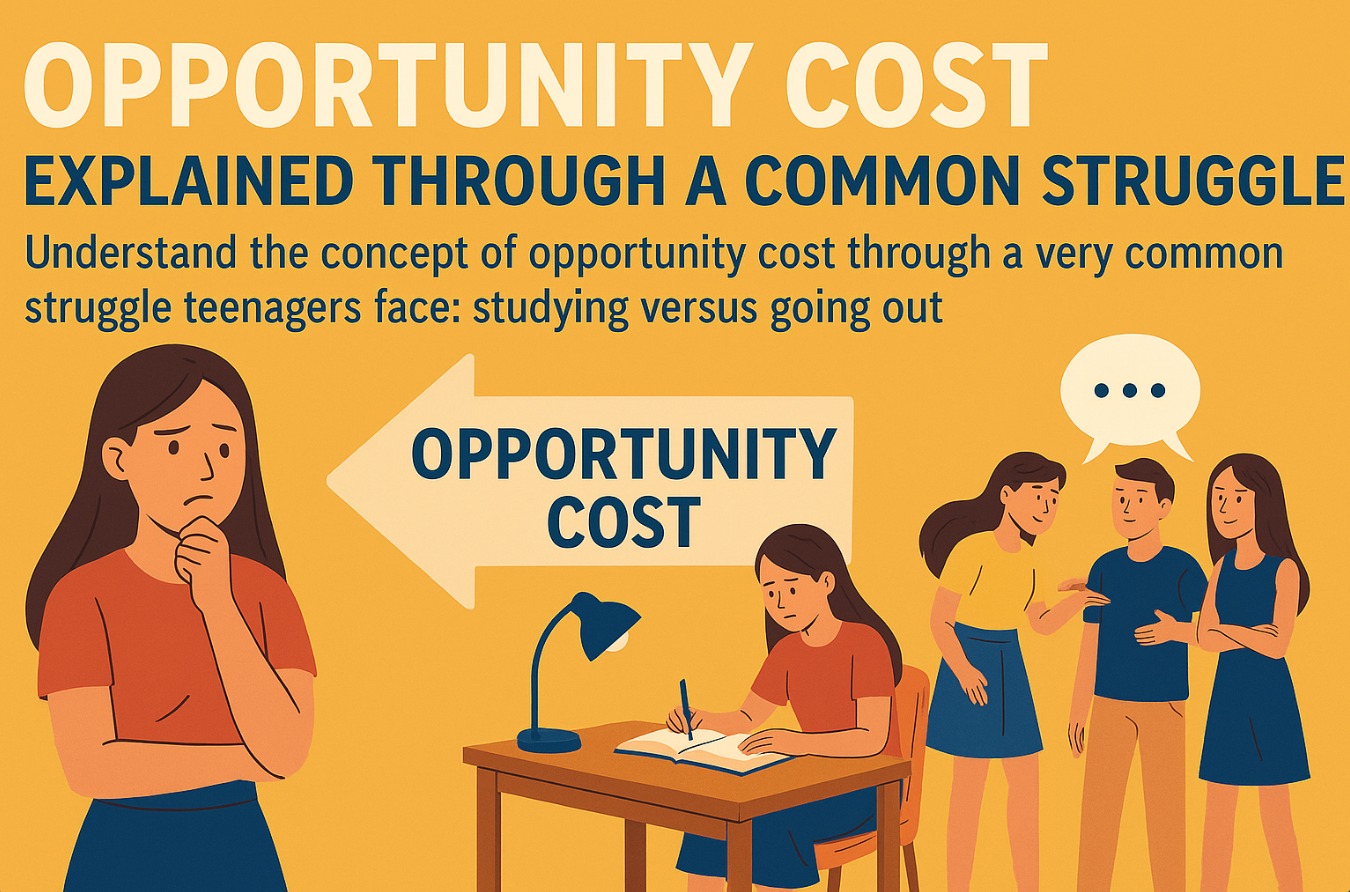
What is “opportunity cost”? Although it may sound confusing, opportunity cost can be explained through a struggle almost all high schoolers go through: deciding between staying home to study for an upcoming test or going out with friends. Whether you choose to study or party, you miss out on something just by choosing. This is called opportunity cost.
The value of the road not taken
Opportunity cost is the loss of a potential gain you could have benefited from when one alternative is chosen over others. Simply put, it is the value of the second-best option that was not chosen.
Considering the studying vs. going out problem, the opportunity cost is the potential benefit you lose. If you choose to study, the benefits you gain are being better prepared, reduced chances of having to cram, and lower stress because you didn't procrastinate. However, the opportunity cost of this choice — the benefit you lose by choosing it — is the experience and time spent out with your friends. If you go out instead, the reverse is true: you gain the fun experience, but the opportunity cost is the revision time, which may affect your test results.
Explicit vs. implicit costs
The concept applies to both explicit and implicit costs. Explicit costs involve money spent on a purchase, while implicit costs — like in the scenario above — involve non-monetary sacrifices such as time, experience or even rest.
The takeaway
Opportunity cost is the value of the direct alternative chosen over the original option — the possible benefit you sacrifice when choosing one thing over another.
Recognizing opportunity cost as more than just an economic concept can also help with making smart decisions in daily life, such as deciding whether to spend on something you aren't sure you need or to save for the future. Every choice has a cost, whether explicit or implicit — and opportunity cost helps you see it.