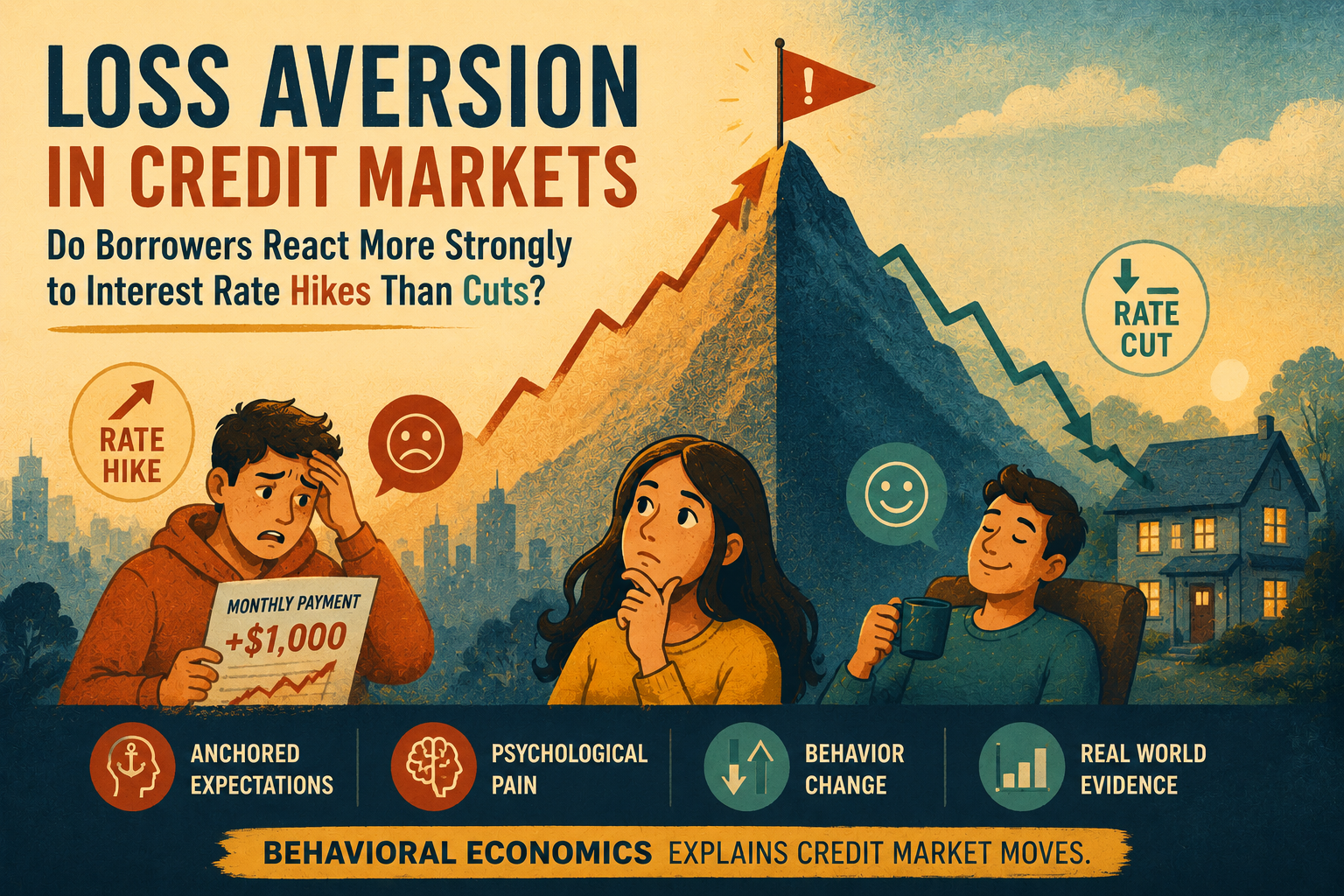
Imagine your phone plan gets $10 more expensive. Annoying, right? You'd probably complain about it for a week. Now imagine it gets $10 cheaper. Nice — but would you even mention it to anyone? That lopsided reaction is loss aversion, and it quietly shapes one of the biggest markets in the world: credit.
Losses loom larger than gains
Loss aversion, first described by behavioral economists Daniel Kahneman and Amos Tversky, says that the pain of losing something is roughly twice as powerful as the pleasure of gaining the same thing. Losing $100 hurts about twice as much as finding $100 feels good. Rational economics assumes people weigh gains and losses equally — behavioral economics shows we absolutely do not.
The asymmetric borrower
Now apply that to borrowing. When central banks raise interest rates, households with loans and mortgages react fast: they cut spending, rush to refinance, or panic about repayments. A rate rise feels like money being taken away — a loss. But when rates fall by the same amount, the response is far weaker. Borrowers are slow to refinance, slow to increase spending, and often don't even notice the saving. A rate cut feels like a gain, and gains simply don't grab our attention the way losses do.
This asymmetry shows up in real data. Studies of mortgage markets repeatedly find that borrowers respond more strongly to payment increases than to equivalent payment decreases, and many households fail to refinance even when doing so would save them thousands — a phenomenon economists politely call “refinancing inertia”.
Why lenders care
Banks and lenders understand this psychology, and it shapes how credit is designed. Teaser rates work because the low starting payment becomes the borrower's reference point — any later increase is felt as a painful loss, but by then the loan is signed. Penalty fees are framed as losses to be avoided, which motivates on-time payment far more effectively than an equivalent reward would. Even the phrase “protect your credit score” is loss framing: it's about not losing something you have.
The takeaway
Credit markets aren't just about interest rates and repayment schedules — they're about how those numbers feel. Borrowers overreact to rate rises and underreact to rate cuts because losses loom larger than gains. Next time a rate change is in the news, watch the reaction: the size of the outcry will tell you the direction of the move before the headline does.