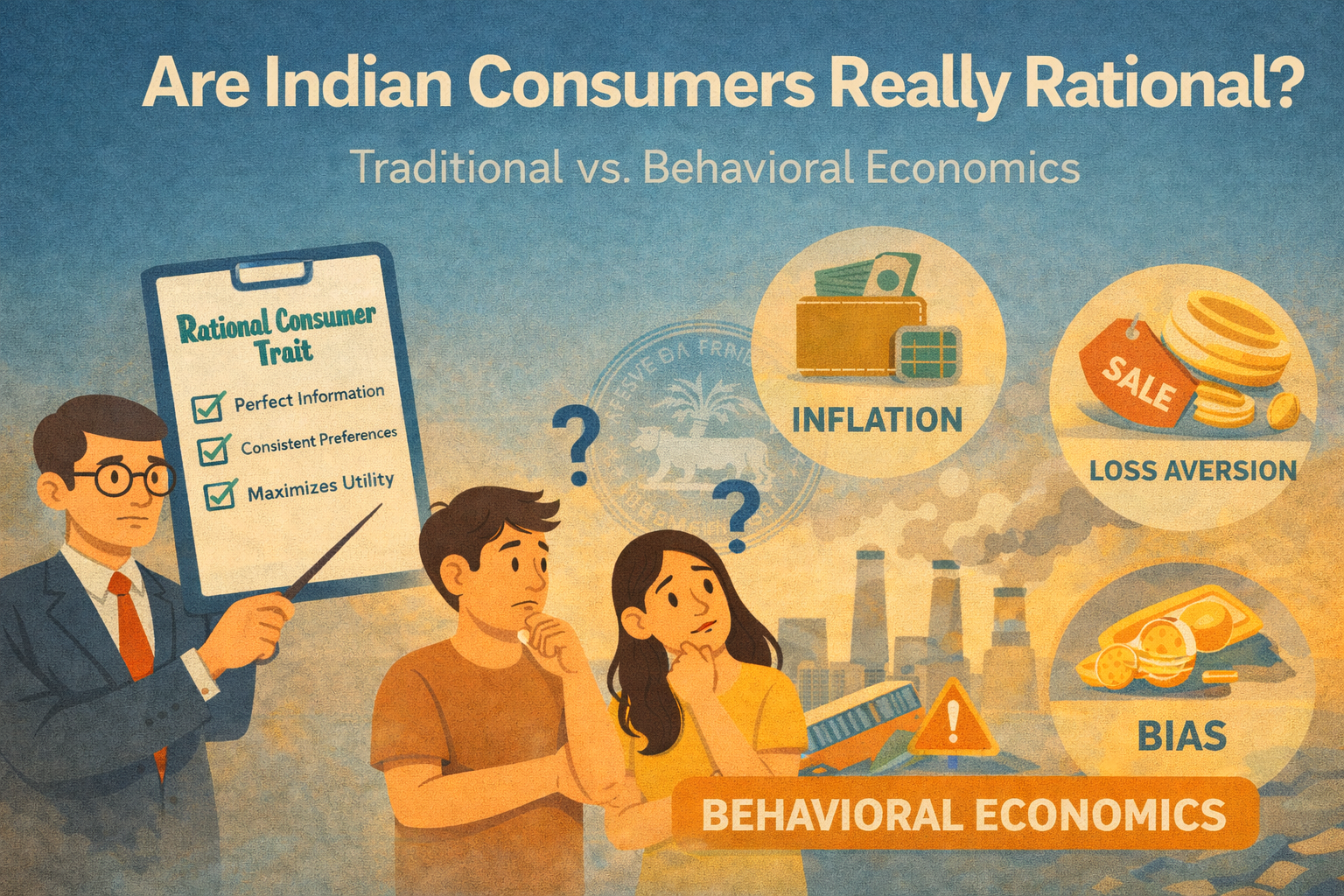
In traditional economics, economists often rely on assumptions of consumer rationality: that consumers have access to perfect information, hold consistent preferences, and aim to maximise their utility within budget constraints. Modern economics, however, suggests that consumer rationality is limited — giving rise to behavioral economics and to the question: are Indian consumers really rational? Expecting everyone to have perfect information is nearly impossible, giving rise to bounded rationality, where an individual's ability to make rational choices is limited by constraints. When someone buys a new phone, can we truly assume they knew everything about the phone market before choosing — or did they simply buy what most of their friends have?
Expectations drive consumption
One factor is the influence of expectations. Inflation expectations are a prominent example: surveys by the Reserve Bank of India show a persistent gap between households' inflation expectations and true CPI inflation. Inaccurate perceived inflation directly impacts spending habits, often as increased short-term spending — suggesting the beliefs consumers hold can be irrational.
The RBI also finds that households' inflation expectations adjust slowly, indicating adaptive expectations — expectations about future conditions that update gradually as new information arrives. This too challenges the rational-behavior assumption that consumers form future expectations efficiently.
Loss aversion and present bias
Loss-averse and precautionary tendencies also drive consumption, rather than pure logic. Buying a shirt you don't actually need just because the online discount is about to expire is present bias — choosing immediate rewards over long-term benefits, caring more about missing the sale than about the item itself. On a larger scale, data from the Ministry of Statistics and Programme Implementation shows households cut spending quickly when prices rise, but don't increase spending by the same amount when inflation drops — highlighting loss aversion. Further, RBI data shows households deposit more in banks when they are less confident in the economy, preferring safety over future utility maximization.
Loss-averse tendencies also fuel impulse spending, since the fear of missing out on short-term gratification outweighs the value of saving — visible in UPI transaction volumes spiking during promotional cycles, as recorded by the National Payments Corporation of India.
Biases and heuristics
Availability bias shapes consumer perceptions too: people judge inflation by the prices of goods they see most often. Per the Ministry of Statistics and Programme Implementation, consumers' inflation perceptions overweight frequently purchased goods like groceries and fuel, even when overall inflation is stable. Anchoring bias plays a role as well, where judgments are distorted by the first piece of information received.
Mental shortcuts — heuristics — also direct behavior. When inflation rises, Indian households famously allocate savings toward gold, an investment with deep cultural significance. This cultural heuristic in savings decisions further challenges assumptions of pure rationality.
The takeaway
While traditional economics assumes rational consumer behavior, the trends studied by modern economists suggest psychological factors drive decision-making. Given the influence of expectations, precautionary tendencies and biases, Indian consumers — like consumers everywhere — are not perfectly rational.